image_pdfimage_print

Component parts

My good friend and colleague, Joanna Schrieber, and I are finishing up a collection that encourages the field of technical and professional communication to move past an impulse to define what the field is and is not. Instead we encourage scholars to consider TPC as a big box that is filled with lots of component parts. Shifting to the view, component parts allow for the diversity of approaches to research and allow for understanding the field through lens of diverse organizations where TPC is practiced, Moreover, it gives scholars (and practitioners) the opportunity to draw on the parts they need at any given moment,. This somewhat modular approach means that arguments can be made about what TPC is and does based on the context.

It was a conversation with Joanna that inspired the exercise that you’ll have coming up on creating Venn diagrams. A venn diagram is a visual way of showing parts of something. In this case, I asked for students to think through how they were seeing the component parts of composition theory, as well as the component parts of the teacher/scholar identity. The latter Venn digram intersects with one my consistent refrains when talking with graduate students: you have to know who you are as a teacher and a scholar. Gaining an understanding of the components of your identity as teacher and scholar can help you with planning and strategizing toward your overall goals and objectives. It helps to give a concrete path forward.

I ran across this Venn digram about life and in general. I share this here because it can add another dimension to the thinking about your own component parts–what are those things that are important to you–of your scholarly trajectory.
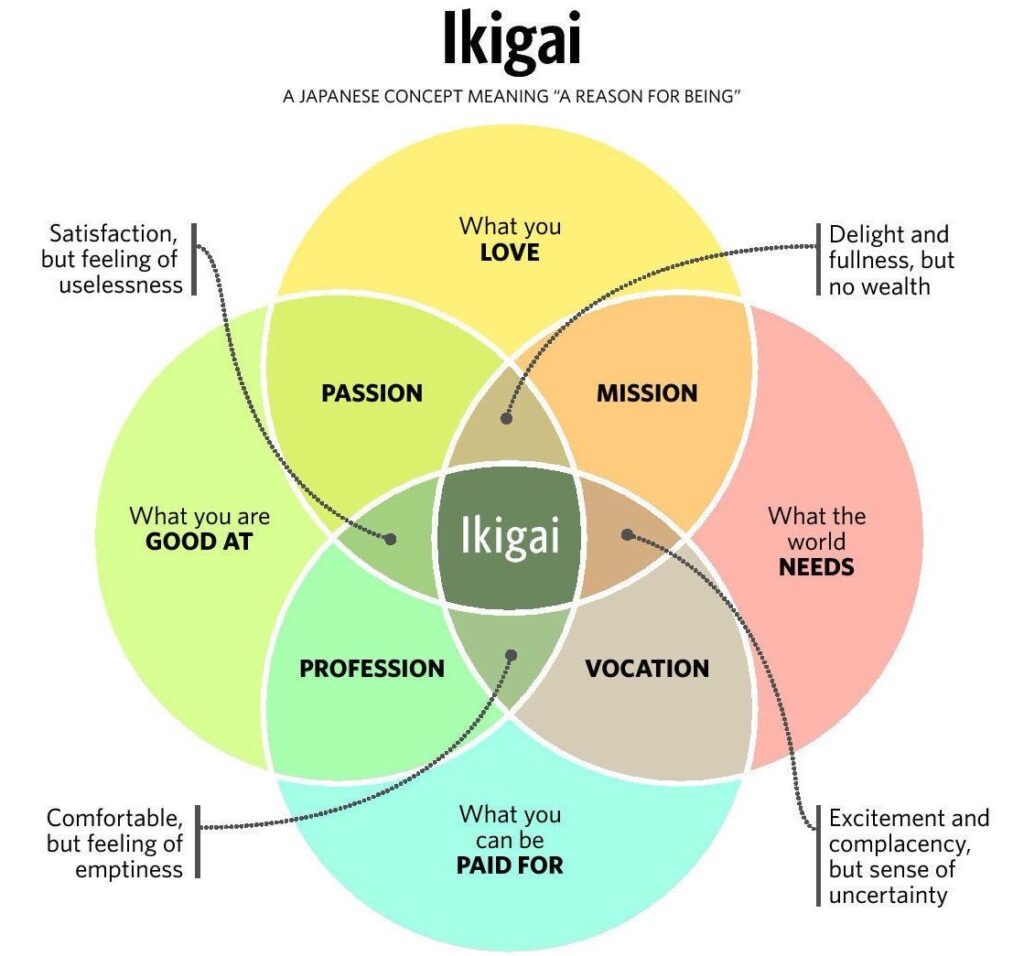
 

What I like about this are the underlying questions that one an ask themselves as you are pondering your own goals and objectives. A graduate degree is a big step and life changing so it’s important that you are consistently reflective and reflexive along that path.

Here is my own Venn diagram that is similar to what I asked you to create:
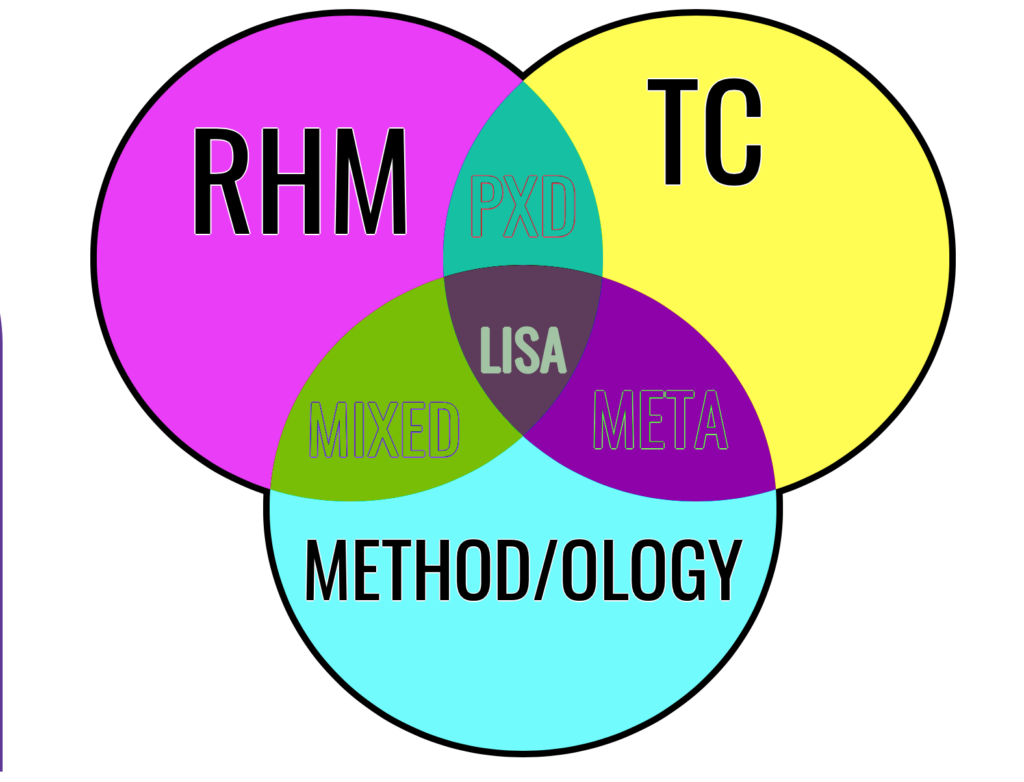
This identifies three major components to my scholar/teacher identity

  • technical and professional communication
  • rhetoric of health and medicine
  • method/ology

The overlaps are key ways that these areas intersect with one another. For example, my work in TPC overlaps with RHM specifically around a concept of patient experience design (PXD).

While TPC and methodology overlap in areas in meta-research where I have looked to establish ways of both seeing the field methodologically while invoking forms of methods that can open up insights into the data about the field. Method/ology overlaps in RHM with mixed approaches to doing research in RHM. I could have chosen any number of ways to do the overlaps. I settled on these because in some ways they highlight the important component parts of not only my own identity, but also those of the fields.
Presentations and Such

I write this before class, which tonight will be all about lightning talks on your counter stories.

But, then like last week, we’ll have some time to talk about uncovering “hidden curriculum” things or talking our way through making sure all students understand things openly and inclusively. The days where graduate faculty assume that students should know things is way over. Instead, it’s way past time to make sure there are no hidden or unwritten rules or we openly talk about assumptions and starting places.

While some in graduate programs want to spend every second on the readings cause there are hundreds of pages to get through a week, my approach is different. As you know we read a couple or three things, then you’re set loose on your own path. What that does is frees up some class time to do other things just as an important as learning the scholarship in the field. That is, we need to make sure we are teaching graduate students how to do this job and making clear what skills they are learning that can be transferred to a job in higher education or a job outside of higher education. This has been my stance for a few years, but this year in the midst of a pandemic and a collapsed job market that will take years to recover (if it ever does) it’s more important than ever.

So tonight we’re gonna end the class talking about what makes a good presentation, which is why y’all had to read things about presentations and design and nothing else. It’s a skill to be able to hone in on the main idea that you really want people to know, and with academic topics filled with nuance and complexity this skill becomes even more important. But we don’t really talk about it and teach it. That’s why we are still sitting through presentations at conferences that never really make a point!

We’ll also spend some time talking about how to choose conferences to go to, how to prepare for one, how to write abstracts, and other specifics to things associated with conferences and presentations.

I hope this conversation tonight leads to some other questions we can tackle in the last weeks of class. There is so much to cover about strategies in getting through grad school (that carry over into other roles) and topics that are of importance in making sure students know how to navigate grad school with their mental health intact. So be thinking of questions. And if you don’t want to ask them out loud in front of the other students, you know how to reach me.

The meaning of “and such” in the title this post is to make sure you know we can and will always make time to answer those questions that never seem to have a place anywhere else.

Knowing nothing is something

You often hear me say in class and in our conversations that “I have nothing.” This statement likely needs a bit more explanation. What it means is that I have no definitive answer or in some cases no answer at all to your question

Sure, I can likely formulate a position or posit a for of an answer, but I typically default to the idea that I don’t really have anything to say at the moment. Many of the questions. Y’all ask in class or in advising are multi-layered and complicated, and I hesitate to start an “answer” because part of what you need to do in grad school is to work through your own answer without the influence of someone else’s voice in your head.

And you’ve heard me say this before, too. I don’t want you to be like me. You need to be like you. What I want you to do in grad school is to grow into yourself and learn a confidence associated to that, and I can help you with that no matter what you may want to research. Cause the research may get you the PhD (via your dissertation), but research for most academics is not the focus of your job. So to me, your research topic is only a small sliver of who you are or who you will be. That means I don’t have to know everything about your topic or even the course I’m teaching. I just need to give the resources to find out what parts of the field and its scholarship may resonate with you.

The other meaning of “I got nothing” is I’m still thinking the issue at hand, and I haven’t settled on anything yet. For example, when we were talking about outcomes and assessment in class (link to 9-30), we hit upon a spot of my own thinking as I work through what these terms may mean programmatically. While I totally buy into what I wrote with my co-authors, there are still some unanswered questions to consider around issues of diversity, inclusion, ethics, and fairness. All of these terms go along with the concept of opportunities for advancement. I’m mired in my own thinking right now so I needed to be honest about that.

The ability to openly acknowledge that we may not have all the answers, that knowledge making is often always in process, that we need to always be open to alternative perspectives and approaches is also a big key of graduate education. Believing in what you do know but always making room for things we don’t bring with it its own sense of freedom and confidence and know-how.

Self-evident truths

Let’s call them the truths I hold to be self-evident about graduate education.

graduate education is about YOU and YOUR ideas

And making those ideas stronger and gaining more knowledge about them. The point here is it truly is totally about you.

See next self-evident truth

my job is support and facilitate YOUR learning

This means that my one and only job is to support you in those endeavors. I have a fuck-ton of faults. Most of them I am painfully aware of. But, the thing I know I can do—and can provide you evidence of it—is that I do know how to help you craft better arguments, to help you write better, to provide generative feedback, to point you to sources and resources. These are things I can do, that I will do for you. Happily. Because not only is it my job, I get a great deal of joy watching y’all learn and grow as thinkers and writers.

we do not have to agree

Yup! Believe it or not, I do not have to agree with your stance and you sure as hell don’t have to agree with mine. I want you to be your own people, your own thinkers, and honestly, I am most delighted when we don’t agree cause that means you are growing into and being able to justify your OWN beliefs and your own knowledge. I celebrate those moments with you.

you are in charge of your own education

This one intersects with the others, and it is also the driver of the way I run classes. I want you to control the direction of your education in ways that work for you. While theories of learning based on types has been debunked, I totally buy into the fact that each one of you learn differently and more so, you have different goals. That means we have to find ways to meet you where you are to chart a path of where you want to go. I can definitely help and assist you down that path.

All of this is to say….virtual spaces make it even more difficult to get an understanding of people. I get that I am odd and different than most professors/academics. But I have utterly failed you if for one second you think you can’t do what you want in your own learning.

Please take these self-evident truths as exactly that. You can find no stronger and more passionate advocate for your educational journey than me. That’s my commitment to you. It’s up to you to take a leap of faith and believe in that.

How to read

It is no secret that I am critical of current scholarship (see here. and here.). Not only have I published about this, but you have heard me talk about it in passionate ways. I’ve written about reading here.

But, I want y’all to be better than me. So I want to encourage you to read constructively and critically. Yes. We still need criticism and pointing out where things can be improved, but it’s more productive, especially early in your careers, to concentrate on both what is good and what can be improved.

In thinking in these terms, you can better pay attention to what it was the author was trying to do, respect that action, and then consider ways that it would have been better. In challenging both the author and our own assumptions, we stand a better chance of reading scholarship in a productive way.

No matter what way you want to invoke a text, you need to be certain that you can

  • explain what the main argument is
  • describe the stakes of the project
  • identify the conversations that is trying to address

Reading productively does not mean you have to agree (or disagree) with anything, but it does mean that you need to be able to say why and how it could be improved. It’s also important not to just focus on where the argument or the piece fails. Grant, that’s where I typically go first, but as I say, I want you to be better than me (and I’m also got a few years experience on you). So what that means reading should lead to you being able to use it for something or to know without doubt that it does not apply to your project or your research trajectory.

Some questions that are more generative than looking at what is missing or where it goes wrong are

  • what does this scholarship do to help us think better or differently?
  • In what ways does it open up an avenue on which we can build?(even if it is only a slight thread)
  • what can I learn from this?
  • how does this work with, complement, contradict, [your own word here] things I already know or believe?
  • what knowledge systems does this piece hold up or challenge?
  • what is missing that needs to be expanded?/
  • how can my critique of [insert one thing that is bothering you about it] be shifted to change he way we see [term, concept, idea, problem]?

These questions can help you make sense of the scholarship in a more productive way and to in the words of the course work toward putting knowledge into action. Critique requires specificity and it also requires follow-up action.

Expectations

What this means for you as a student in a class where I’m designated as teacher is that I know how hard it can be to juggle life and school; I know most of the tricks that give the allusion that you’re doing things when you’re really not; I understand how it can be to learn new things, particularly things that challenge your own assumptions, beliefs, and attitudes. So I’ll be as understanding and empathetic and sympathetic as I possibly can.

But….you knew that was coming…..

Because whether its required course or not, you are here because you want to be. You made the decision to come to graduate school, and I’m here to help you anyway I can.

I like to get out of the way a few things so that you know

  • what my expectations are about your participation
  • what you can expect of me
  • what are expectations about professionalism

Expectations about your participation

If it’s listed on the schedule that you need to do something before class, I truly do have the expectation that you’ll do it before class and come prepared to work with that knowledge in class. Do you have to be expert in it? No. Cause that’s why you’re here. But you need to have a damn good idea about some of the major takeaways OR come prepared with some questions so we can get you to those takeaways.

I also have the expectation that for those three hours a week we see one another that you’re going to really try and be engaged for those three hours. I know these block classes are hard. They’re hard on us all, but we’re going to do the best we can. One of the ways we do this is to move and to play and to make and to question. All of these require your participation and they also require stepping outside of your comfort zone at times. All I ask is that you try and not be afraid to fail cause that’s part of the learning process.

You will have to invest about 3-9 hours (this all depends on you, but this is a rough estimate from past classes) outside of class to achieve the goals of the course. As in any new work routine, students may need more hours during the initial weeks as they learn to carry out the assignments in a way that balances efficiency (time required) and effectiveness (extent of coverage, depth of comprehension).

If you have concerns as we move through the term, please talk to me about them.

Your assignments should be carefully written and edited and fulfill the requirements of the assignments. They should be approached with a professional attitude and demeanor and be professional quality.

Expectations about me

One of the most important things you can expect from me is having an inclusive classroom. What that means is our classroom is a space where we can have open, fruitful discussions and all opinions and points of view will be respected. It’s also a space where I’ll work with you to make allowances for different types of learning abilities.

In addition, my job is to

  • Establish the objectives, assignments, and schedule for the course.
  • Share my knowledge and opinions about topics covered in the readings (where you can disagree if want)
  • Facilitate the transfer of information between and among students through discussions of assigned readings
  • Encourage students to express their opinions and formulate their own arguments on the topic at hand
  • Help students make connections between their existing knowledge and the information being presented in class
  • Publish and maintain the course website that contains policies, readings, assignments, and related information about the course
  • Be readily accessible to students during my office hours or through email.
  • Review and offer directive and formative advice on plans and drafts related to the assignments

Moreover, I have and always will run an open classroom. What that means is you can ask me anything in class or out. Openness means, though, that the classroom is a safe, open space so if you are unsure how to raise a particular issue where we can discuss it safely and openly then ask me outside of class how to do this.

Expectations about professionalism

I recognize that this term, “professionalism,” can be construed in any number of ways and can be considered something of a negative by some people. So for me and the way I’m using this term is that every graduate course is a mini-lesson in your professionalization, which is a set of habits and practices that are often expected of employees in the vast majority of organizations. (And I get that “professionalism” and those habits and practices are often coming from a place of inequality, racism, and discrimination. That’s part of our job as critical thinkers to learn how to operate in one while trying to dismantle at the same time.)

Yes, even academics have things that mark them as professionals, and more importantly, good professionalism often means that your colleagues think that you are actually a good colleague rather than simply someone they must endure. I want you to grow into a professional scholar/teacher that enjoys what they do and that folks want to work with.

You have the opportunity to continue to develop necessary professional skills, such as reliable communication with me and your classmates, problem-solving approaches, cooperation and collaboration, to name but a few. Use this time wisely to try out new approaches and techniques.

And ask questions. There are lots of things I don’t know you don’t know. I can’t help you unless I know what you need. I do understand that you may not even know how to format he question, but you have to figure out a way to let me know where you’re struggling and we can figure out the question and answer together.